


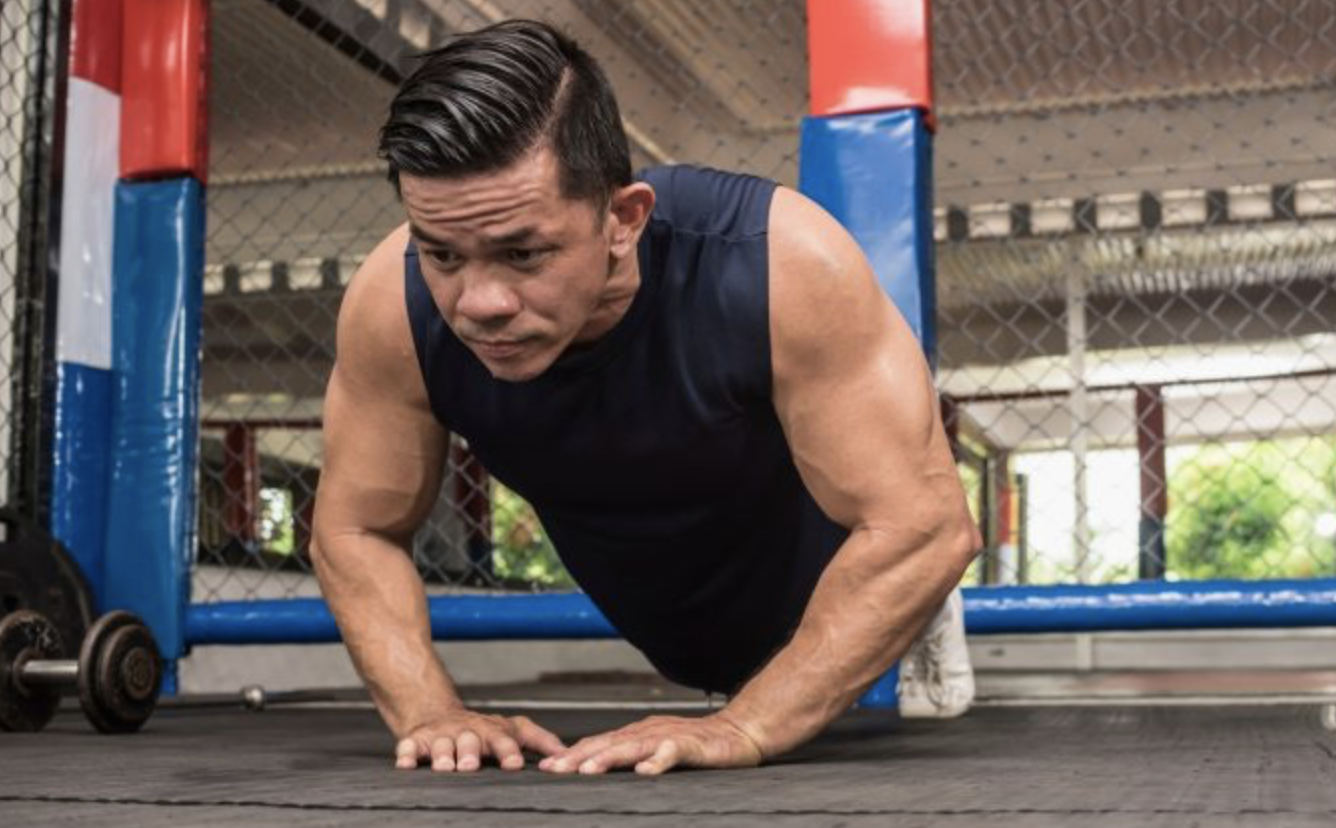
The Push-Up – A Foundational Strength Exercise
As one of the most fundamental movements in any workout program, the push-up is far more than just a simple upper-body exercise. It builds strength, endurance, and control using only your bodyweight, making it accessible yet highly effective for beginners and advanced athletes alike.
Despite its simplicity, the push-up remains one of the most powerful exercises for developing functional strength that carries over into real-world movement and athletic performance.
Muscles Worked During Push-Ups
The push-up primarily targets the chest muscles, but its benefits extend well beyond that. Depending on hand position, tempo, and body angle, it engages multiple muscle groups at once, including the chest, shoulders, triceps, and core.
This makes it a compound movement that not only helps build a bigger and stronger chest but also improves overall upper-body coordination and stability.
Benefits Beyond Muscle Growth
Push-ups offer more than just aesthetic improvements. Research suggests that a higher baseline push-up capacity is associated with a lower risk of cardiovascular disease events. This highlights the exercise’s role in supporting overall health and long-term fitness.
In addition to health benefits, push-ups help improve muscular endurance, posture, and core strength, making them a valuable addition to any training routine.
Why Push-Ups Improve Strength Performance
Mastering proper push-up technique and exploring different variations can also enhance performance in major compound lifts such as the bench press and overhead press. By strengthening stabilizing muscles and improving pressing mechanics, push-ups help build a stronger foundation for heavier lifts in the gym.

How to Perfect Your Push-Up Technique
Luckily, the push-up is far less complicated than something like the clean & jerk. Still, it’s critical to perform any exercise with the correct technique for safety and efficiency — and it’s not different in this case.
Because push-ups can place quite a bit of stress on your wrists, being aware about the alignment of your hands can go a long way in staying pain- and injury-free. In addition, knowing how to position your elbows can make a major difference in completing a clean rep or setting the stage for potential shoulder problems.
The Push-Up
If you want to ensure you’re getting the most bang for your buck, here’s what you need to do to perform the perfect push-up.
- Start in a “high plank” position with your hands slightly wider than your shoulders and your elbows just slightly bent. Maintain straight legs without dipping your hips toward the ground or hiking them upward.
- Engage your core by pulling your belly button toward your spine.
- Slowly lower yourself to the floor, making sure to keep your elbows tucked close to your sides as your arms bend toward a 90-degree angle.
- Once you reach the bottom of the movement, contract your chest and triceps muscles and push back through your hands until you reach the starting position.
Muscles Worked During a Push-Up
Although many people look at the push-up as solely an upper body exercise, it’s actually a closed kinetic chain movement that involves multiple muscle groups from head-to-toe. Of course, since push-ups primarily involve the pectorals (major and minor) and triceps, it’s easy to see why they’re a popular choice for chest and arm day programming.
Yet when you consider the full scope of what the movement entails, you could make the argument that a push-up is truly a full-body exercise. After all, not only do you need to utilize your pecs, triceps, and shoulders, but you also have to recruit your abdominal, lower back, and leg muscles to perform a proper rep.
Here’s a breakdown of how and when the primary and secondary muscles are recruited during a push-up.
Pectoralis Major
The largest of the chest muscles, your pectoralis major is a thick, fan-shaped muscle that acts as the agonist (primary mover) during a push-up. It consists of two heads: the clavicular (which originates from the front surface of your clavicles) and the sternocostal (which originates from your sternum and upper ribs).
The pec major lengthens and stretches as you lower yourself down during the eccentric phase of a push-up and it contracts as you push back up to the starting position.
Pectoralis Minor
Located under the pec major, the pectoralis minor is a small, triangular muscle that originates from the third to fifth ribs and inserts into your scapulae (shoulder blades). Although it pales in comparison to the size of its larger cousin, it still plays a critical role.
As you perform a push-up, the pec minor keeps your scapulae in position. However, tightness in this muscle, or having relatively weak rotator cuff or scapular stabilizers, can lead to discomfort and imbalances. This makes upper body mobility work particularly important.
Triceps
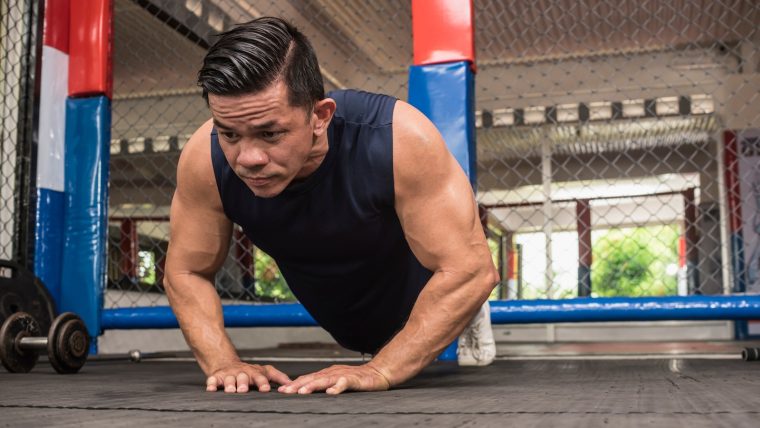
Besides the pec major, no muscle benefits more from the push-up than your triceps brachii. Located on the back of your upper arm, this three-headed monster includes the medial, lateral, and long heads — each of which has a unique origination point.
During the initial phase of a push-up, the triceps helps stabilize your torso. Then, once the muscle is under tension, it takes over as the agonist when you extend your arms to lockout the top of the movement.
Anterior Deltoids
Similar to the triceps, the deltoids are comprised of three heads (anterior, lateral, and posterior). These large, triangular muscles are located on top of your shoulder joints, with the anterior head playing the most active role during a push-up. Besides assisting with shoulder stability during the eccentric phase, your front delts also help bring your arms inward towards your chest during the concentric portion of a push-up.
Core
Your core will receive a wake-up call when you perform a push-up, too. Comprised of five main muscles — the rectus abdominis, transverse abdominis, internal and external obliques, and the relatively small pyramidalis — your abdominals work synergistically with your erector spinae to keep your torso straight throughout the movement.
Failing to keep your core engaged from start to finish can affect your total-body position and alignment. Ultimately, poor core control may put you in a compromising position that could cause problems, or even pain, down the line.
How to Target Particular Muscles During a Push-Up
The basic push-up does a solid job of recruiting several muscle groups, namely your chest and triceps, and even upper back for stability. However, you don’t always have to subscribe to the standard form, especially if you have specific muscle-building goals in mind.
Prioritize Your Triceps
To focus on building your arms, all you need to do is change your hand placement, as studies show that a narrow-width push-up provides more triceps activation. (2) The closer you put them together, the more you will shift the focus away from your pecs and toward your triceps.
While a close-grip push-up will certainly get the job done, you can make this triceps-centric exercise even more challenging by forming a diamond shape with your hands. Place your index fingers and thumbs so they touch, engage your core, and carefully lower yourself to the floor. Your triceps may detest you at the top of a diamond push-up, but they’ll thank you later for giving them direct attention with however many reps you get through.
Target Your Upper Chest
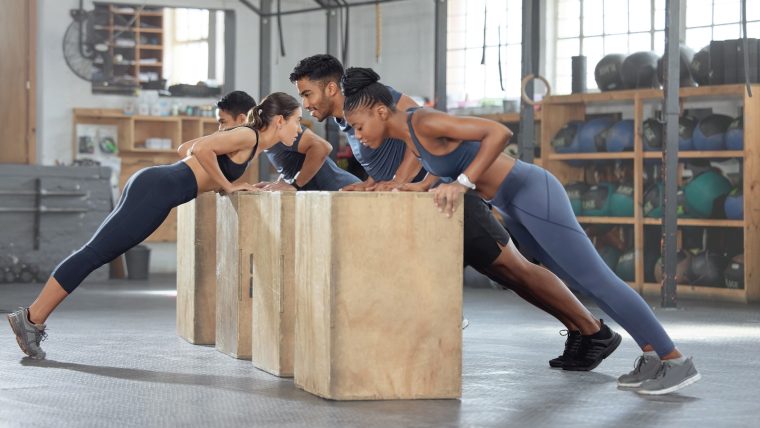
To emphasize your upper chest, steal a page from the traditional weight training playbook and press at an incline instead of a flat angle. To make this adjustment during a push-up, you must elevate your feet.
Although it may seem counterintuitive on the surface, doing a decline push-up — so named because your body is technically “declined” with your head lower than your feet — provides a stronger stimulus for the upper part of your pectoralis major than the standard version.
You can use a weight bench, plyo box, yoga blocks, or even stairs to turn an ordinary push-up into something that’ll help you develop more thickness at the top of your chest and let you fill out your t-shirts just a little bit better.
Activate Your Lower Chest
If you’re looking to build more muscle on your lower chest, take the exact opposite approach from targeting the upper portion. Rather than raising your lower body to stimulate your upper chest, place your hands on a step, platform, bench, or other apparatus to perform an incline push-up.
Changing your leverage and pressing angle in this manner will let your lower chest take on a more active role despite the more limited range of motion.
Push-Up Variations for Building Strength, Muscle, and Power
While the targeted variations outlined above are a solid start, they’re just the tip of the iceberg. Whether you’re an athlete looking to increase your power or a home gym enthusiast who wants to incorporate dumbbells into a push-up, there’s a wide range of push-up variations that’ll serve your needs.
Here are three favorites that you should consider adding into your training regimen.
Plyometric Push-Up
An advanced variation tailor-made for athletes, the plyometric push-up (more commonly referred to as the plyo push-up) adds an explosive element by recruiting fast-twitch muscle fibers. Not only does it strengthen your chest, core, triceps, and shoulders, but it also can help improve your conditioning when performed as part of a high-intensity interval training (HIIT) workout.
Fitness Tip: Plyo Pushup
How to do it:
- Start in a high plank position with your hands directly under your shoulders.
- Brace your core and lower yourself down until your elbows are at a 90-degree angle.
- Engage your chest and triceps to push upward with sufficient force so that your hands actually leave the floor. (Optional: Clap your hands together at the top.)
- Land lightly on the ground in the same starting position, then perform the next rep immediately.
Renegade Row Push-Up
You can kill two birds (aka your chest and back) with a combo move that incorporates dumbbells into the ultimate push-pull exercise. The renegade row push-up is by no means easy, but it’s an effective example of how to superset exercises for better efficiency and results. Essentially, you’ll be working your pecs, triceps, lats, rhomboids, and core, all while working to maintain stability and balance during this dynamic movement.
One note on this variation: The closer your feet are to each each, the harder it will be on your core. A wider stance will offer better stability and reduce the core-training challenge.
Renegade Row with Pushup
How to do it:
- Place a pair of dumbbells on the ground about shoulder-width apart.
- Place one hand on each dumbbell with your palms facing in, so the weights are parallel to each other.
- Set up in a high plank position with your feet shoulder-width apart to start.
- Lower yourself down until your elbows reach a 90-degree angle.
- As you push back up, keep your body in a straight line and, at the top of the push-up, perform a dumbbell row by pulling the dumbbell up toward your ribs on one side.
- Lower the dumbbell back down and perform another push-up, followed by a row with the opposite arm. Repeat in alternating fashion.
Spiderman Push-Up
Demanding, dynamic, and definitely not meant for beginners, the Spiderman push-up is a great way to get your core and lower body involved. This variation will wake up your obliques, rectus abdominis, hip flexors, and quadriceps while still providing more than enough of a challenge for your chest, triceps, and shoulders. Ultimately, your mobility and flexibility will be tested just as much as your strength and endurance.
